Google Opinion Rewards
- 4.5
- Rating
- 100.00M
- Installs
- Free
- Price

 Analysis by App-foxy
Small purchases on Google Play have a way of becoming annoying rather than expensive. I may want to try an app, rent something, or buy an item inside a game, then decide the amount is not worth entering payment details for. Google Opinion Rewards tackles that recurring problem by turning short surveys into Play credit. In my experience, its value is less about making money and more about removing a little hesitation from ordinary digital purchases.
Google Opinion Rewards is a free tools app from Google LLC for Android devices running version 7.0 or later. It is aimed at people who are comfortable answering occasional questions in exchange for credit connected with Google Play. The app is rated for Everyone, and its broad audience is reflected in its reach: it has passed 100 million installs, with an average rating of 4.5 from around 3.8 million ratings.
I would not describe it as a dependable income source. That expectation leads to disappointment. I see it as a low-effort credit collector that can make small Play purchases easier, provided I treat the surveys as occasional prompts rather than a guaranteed daily routine.
You May Also Like

 AccuWeather: Weather Radar
AccuWeather Review: A Quick, Clear Forecast for Everyday Decisions
For everyday plans, the best forecast is the one you can understand quickly. AccuWeather makes rain timing, radar, and local conditions easy to act on, with a few trade-offs.

 Hill Climb Racing
Why Hill Climb Racing Still Turns Crashes Into One More Run
A tiny car, a bumpy hill and one more upgrade: Hill Climb Racing keeps resurfacing because its simple chaos makes every near-miss feel personal.

 AliExpress - Shopping App
AliExpress Makes Global Shopping Feel Personal, but Shoppers Bear the Risk
AliExpress turns a global marketplace into a pocket-sized discovery engine. Its reach is useful, its shopping loop compelling, and its trade-offs easy to miss.

 Lords Mobile: Kingdom Wars
Lords Mobile Is a Kingdom-Building Routine, Not a Quick Match
A case-by-case verdict on the building, battles, device demands, and social commitments that make Lords Mobile rewarding for some players and exhausting for others.

 PDF Scanner app - TapScanner
TapScanner Makes Paperwork Easier to Capture, Check, and Share
TapScanner makes scanning with a phone feel less like a rescue operation and more like a dependable step in getting work done. Its capture tools are useful, though not flawless.

 Block Blast!
 Shows How Much a Puzzle Game Can Leave Out
A quiet grid game shows why puzzle players increasingly value instant clarity, repeatable skill and low-pressure play—and where the genre still needs to catch up.
More From Our News Desk
View All News


How Google Opinion Rewards fits into everyday use
I find the most useful way to fit Google Opinion Rewards into everyday life is to treat it as an occasional prompt, not another task to keep up with. A quick pause before answering also helps me decide whether I’m comfortable sharing the requested opinion and whether I have time to respond thoughtfully. That simple routine makes the app easier to live with, while keeping expectations realistic.
The recurring problem is small, but familiar
The usual alternative to Play credit is using a card, another payment method, or simply skipping the purchase. Those options are perfectly reasonable, but they add a little friction to low-value decisions. A person might want to remove an inconvenience in an app, test a paid utility, or buy something inexpensive without making the purchase feel like a full financial transaction.
This is where the app makes sense. Instead of asking me to commit money immediately, it gives me a chance to answer brief opinion questions and apply the resulting credit later. That exchange is simple, but the timing matters. The credit is most useful when it is already available before I reach the checkout screen.
The important distinction is that the app rewards participation with Google Play credit, not unrestricted cash. That makes it a better fit for Android users who already spend inside Google Play than for someone looking for flexible earnings. If I rarely use Play, the balance has much less practical value.
What the first setup is really for
The initial setup is not merely a formality. I use it to make the app relevant to my habits and to understand what kind of questions may appear. The more carefully I answer, the less likely the experience feels like random tapping. I also pay attention to where the credit is intended to be used, because that affects whether the reward matches my normal purchases.
My advice is to install it before you need credit, not at the exact moment you are trying to buy something. The useful workflow is gradual: complete a survey when one appears, leave the balance alone if there is no immediate reason to spend it, and let small amounts accumulate for a purchase that you would otherwise postpone.
The app comes from Google LLC, which gives the experience a familiar connection to the Play ecosystem. Its current version is 2026051800, and the basic appeal has remained clear since its release on November 5, 2013: answer questions when invited and receive Play credit in return. I find that straightforward arrangement easier to understand than reward services that scatter points across several redemption systems.
A realistic day-to-day scenario
Imagine that I am using my phone during a commute and receive a survey notification. I answer it when I have a quiet moment rather than interrupting something important. Later in the week, I discover a small paid feature in an app I already use. Because the credit is sitting in Google Play, I can make the purchase without reaching for my card.
That scenario shows the app at its best. It does not transform my budget, but it turns an otherwise forgettable few minutes into credit that can cover a modest digital expense. The benefit is especially noticeable when I would have abandoned the purchase because the amount was too small to justify opening a payment screen.
There is also a useful habit here: I separate the arrival of a survey from the decision to spend the reward. The app works better when I do not feel pressured to redeem every small amount immediately. Keeping credit available for a planned Play purchase makes the whole process feel more intentional.
Where the friction disappears
The biggest convenience is that the reward is tied to the Google Play environment rather than requiring a separate cash-out routine. I do not have to compare gift cards, transfer balances between services, or find a buyer for points. For someone already using Android and Play, that direct connection is more practical than a reward program with broader redemption choices but more steps.
It also reduces decision friction. If I have enough Play credit for a small purchase, I can judge the app or digital item on its usefulness instead of immediately asking whether I want to spend fresh money. That does not remove the need for caution, but it makes low-cost experimentation easier.
Another advantage is psychological rather than technical. Surveys are easier to fit around a busy day when I view them as optional micro-tasks. I do not need to schedule a session or learn a complicated interface. The app’s value comes from being available in the background of my normal Android routine, not from demanding sustained attention.
Three practical habits that improve the experience
- Keep the reward connected to a purpose. I get more value when I reserve credit for apps, books, games, or other Play purchases I already expect to make, instead of treating every small balance as spending money.
- Answer consistently and thoughtfully. Rushing through questions defeats the point of an opinion app. Clear, honest answers make the interaction more useful and help me avoid the feeling that I am completing meaningless forms.
- Check the credit before choosing a payment method. When I am about to buy something in Google Play, I look at the available balance first. This simple step prevents me from paying separately for a purchase that the accumulated credit could cover.
These habits are not tricks for forcing more surveys to appear. They are ways to make the rewards I do receive more useful. The trade-off is important: the app can improve the value of occasional participation, but it cannot turn an irregular opportunity into a predictable schedule.
Making the balance useful rather than forgettable
I find it helpful to treat the Play balance like a small-purpose fund, not a reason to browse for something to buy. If I already have a paid app or digital purchase in mind, the credit can reduce what I need to pay from another method. If nothing appeals to me, there is no need to spend it merely because it is available. This distinction keeps the reward from nudging me into purchases I would not otherwise make.
For a household with several people sharing a device, I would also be careful about whose Play account is active before relying on a balance. The practical value depends on the credit being attached to the account used for the intended purchase. Checking that account context before building a plan around the reward can prevent a frustrating surprise at checkout.
Who benefits most from it?
I recommend it most readily to Android users who already download apps, play games, or buy digital content through Google Play. It is also a sensible fit for people who prefer small, low-commitment tasks over longer reward programs. If a few minutes of answering questions can eventually offset a purchase I was already considering, the exchange feels fair.
It is less suitable for anyone who needs cash, wants a fixed earning target, or expects a constant stream of surveys. It is also a weak match for a person who rarely uses Google Play. In that case, even useful credit may sit unused, and a service with more flexible redemption would be more appropriate.
How it compares with the usual alternatives
Compared with paid survey platforms that offer cash or a wide range of vouchers, Google Opinion Rewards is narrower but simpler. The limitation is obvious: Play credit is not as flexible as money. The advantage is equally clear: the reward fits directly into the Android store where many users already spend.
Compared with ordinary loyalty schemes, this app asks for opinions rather than purchases. That makes it accessible to someone who is not shopping regularly, although the reward still has a more specific destination. Compared with doing nothing, it offers a small return on spare moments, but only if I am comfortable exchanging attention and personal opinions for digital credit.
I would not replace a full survey service with it if my goal were maximum earning flexibility. I would choose it when convenience matters more than variety. The fewer redemption steps are a genuine strength, while the restricted usefulness of the reward is the central compromise.
Questions worth considering before installing
A common question is whether this can be counted on for a particular purchase. I would not plan around that. Because survey invitations are occasional rather than a schedule I control, the sensible approach is to use any credit as a bonus toward a future Play expense, not as a payment plan with a deadline.
Another practical question is whether answering surveys requires a long session. The app is best approached as a brief task when it suits you, not as a block of work to fit into your day. If you are busy, leaving a prompt for later or ignoring it is better than rushing through just to clear a notification.
People deciding between this and a cash-paying survey service should start with how they want to use the reward. If flexibility outside Google Play matters, a broader service is a better match even if it involves more redemption steps. If you already make occasional Play purchases and prefer a direct store balance, this narrower arrangement is easier to put to use.
Limits that affect the verdict
The first limitation is irregularity. A person cannot sensibly build a monthly budget around survey rewards because the opportunity to answer questions is not something I can treat like a scheduled job. Some users will find that unpredictability more frustrating than rewarding, especially if they install the app expecting immediate results.
The second limitation is the reward format. Credit for Google Play can be convenient, but it cannot normally replace money for groceries, transport, bills, or purchases outside that ecosystem. Before installing, I would ask myself a simple question: do I regularly want something available through Google Play? If the answer is no, the app’s central benefit is weakened.
There is also a time trade-off. A short survey may feel worthwhile when I am idle, but less so when I am busy or already focused. I avoid opening every notification automatically. I decide whether I have the attention to answer carefully, because a rushed response makes the task feel like an interruption rather than a useful exchange.
Privacy and comfort matter as well. Opinion questions are personal by nature, so I would only use the app if I am comfortable sharing the information requested within the app’s normal experience. The right choice depends on that personal boundary, not just on the promise of credit.
My final judgment
After using it as a practical Play-credit tool, I see Google Opinion Rewards as a good example of a focused utility. It does one thing: it gives Android users a way to turn occasional survey answers into credit for Google Play. That focus keeps the experience understandable and removes several small steps found in broader reward platforms.
The best reason to install it is not earning potential; it is reduced friction on purchases you already want to make. When I remember that, the app feels useful without overpromising. A small balance can make a paid app, game item, or other Play purchase easier to justify, and the process does not require a separate redemption routine.
My recommendation is therefore conditional but positive. Install it if you use Google Play often, can accept irregular survey availability, and are happy receiving store credit instead of cash. Skip it if you need predictable earnings or flexible withdrawals. For the right Android user, this free Tools app is a quiet convenience: not a financial strategy, but a reliable way to make spare moments occasionally pay for something digital.
FAQs for Google Opinion Rewards
01What is Google Opinion Rewards and how does it work?
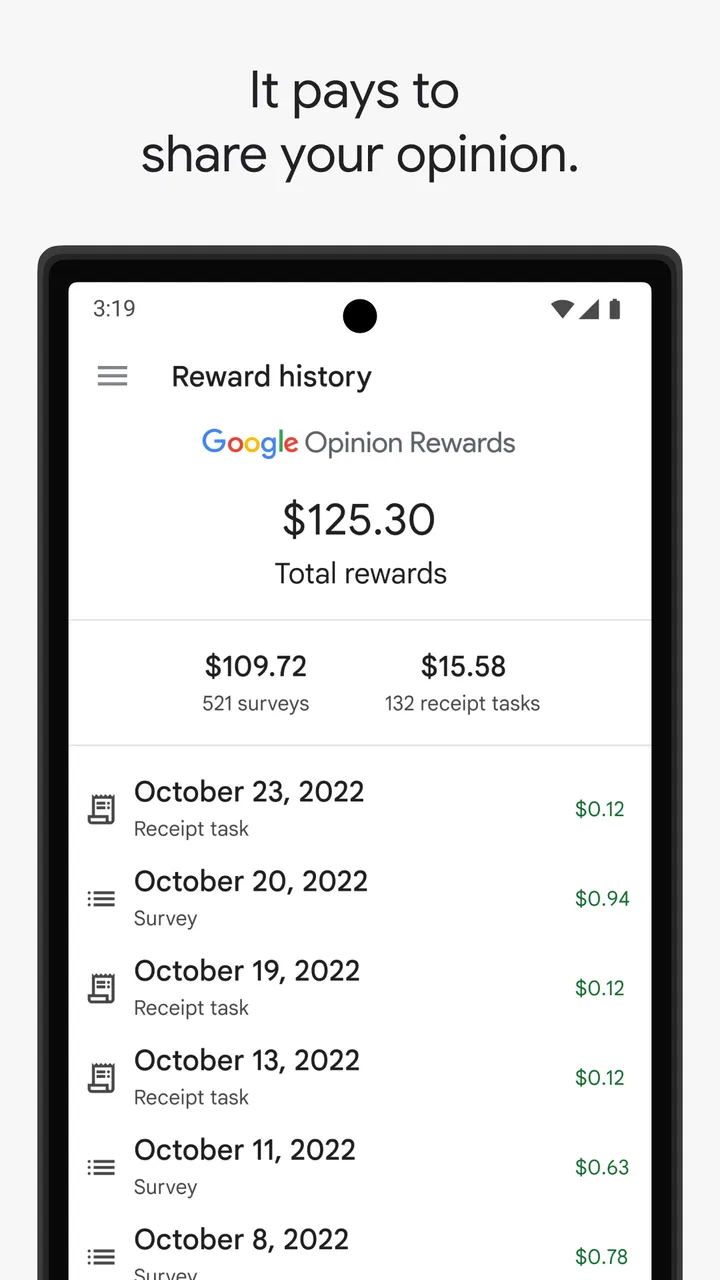
Google Opinion Rewards is an app that allows users to earn Google Play credits by answering short surveys. Users receive notifications when a survey is available, typically about once a week. After completing a survey, credits are added to your Google Play account, which can be used for purchasing apps, games, and other content.
02How often do surveys appear in Google Opinion Rewards?
The frequency of surveys varies, but users generally receive a survey about once a week. The availability of surveys depends on your location, demographic information, and other factors. Keeping the app updated and enabling notifications can help ensure you don’t miss any opportunities.
03Is Google Opinion Rewards safe and secure to use?
Yes, Google Opinion Rewards is safe to use. The app is developed by Google, ensuring that your personal information is protected. Surveys typically ask for opinions and do not require sensitive personal data. It’s important to download the app from the official Google Play Store to avoid any security risks.
04Can I use Google Opinion Rewards on multiple devices?
Yes, Google Opinion Rewards can be accessed across multiple Android devices using the same Google account. Your earned credits and survey history are synced to your Google account, allowing you to seamlessly switch between devices without losing progress or rewards.
05Are there any regional restrictions for using Google Opinion Rewards?
Google Opinion Rewards is available in a number of countries, but availability can vary. Surveys are typically region-specific, which means that the types and frequency of surveys you receive may differ depending on your location. It's advisable to check the app listing in your country’s Google Play Store for availability.
Pros
- Quick and easy surveys to earn rewards.
- User-friendly interface with clear instructions.
- Rewards can be used on Google Play Store.
- Minimal time commitment for each survey.
- Notifications for new surveys ensure you don't miss out.
Cons
- Limited availability of surveys based on location.
- Rewards expire if not used within a year.
- Survey frequency can be inconsistent.
- Limited to Google Play credit
- not cash.
- Requires precise location settings to receive surveys.

Google Opinion Rewards
Gallery